how I ranked a DA5 site in AI Overviews


in this post
I published three articles on a DA5 bakery site to test whether AI Overviews actually reward different signals than traditional SEO. Two of them earned citations within days, right alongside competitors with domain authority (DA) scores 10x higher and thousands more backlinks.
According to research by Ahrefs on AI Overview ranking factors, branded web mentions show the strongest correlation with brand appearances in AI Overviews, even stronger than backlinks or domain authority, which the SEO industry practically worships.
My experiment confirmed exactly that: clarity, structure, and strategic brand positioning can outweigh traditional authority signals in AI-powered search.
Here’s how it worked and what it means for low-authority sites trying to compete.
the current reality: decline in clicks, rise of AI Overviews
With AI Overviews now sitting at the very top of search results, you no longer need to scroll through a list of links to get answers. Google gives you a neatly packaged, AI-generated summary, and sometimes, it cites some sources.
That means fewer clicks to actual websites.
Research from multiple industry sources confirms this trend: AI Overviews reduce traditional organic clicks. And if you’re getting answers directly, why would you have to click multiple links to get the same answer? I know I wouldn’t.
This shift creates a real tension for website owners and content marketers. How do you get seen when Google is doing the answering for you?
That’s what I tested.
the experiment: testing the odds with a low-authority site
I’ve always believed that the best way to learn SEO is to run experiments, not just read case studies. So, when I kept seeing conversations about how small sites might compete in AI Overviews, I decided to test that assumption myself.
The setup was simple: I picked a brand in the baking and pastry industry, with a domain authority of just 5. That’s the kind of site most SEOs would say doesn’t stand a chance against established players in the industry.
I published three different articles. To make the test more interesting, one of them was a Bottom of Funnel (BOFU) piece.
Why BOFU?
Because those are the queries with clear buying intent. The ones where users are actively looking to order or purchase. If a low-DA site could show up there, it would mean real visibility where it matters most.
Then, I waited.
After a few days of publishing, Google’s AI Overview didn’t just acknowledge the site; it cited it right at the top.
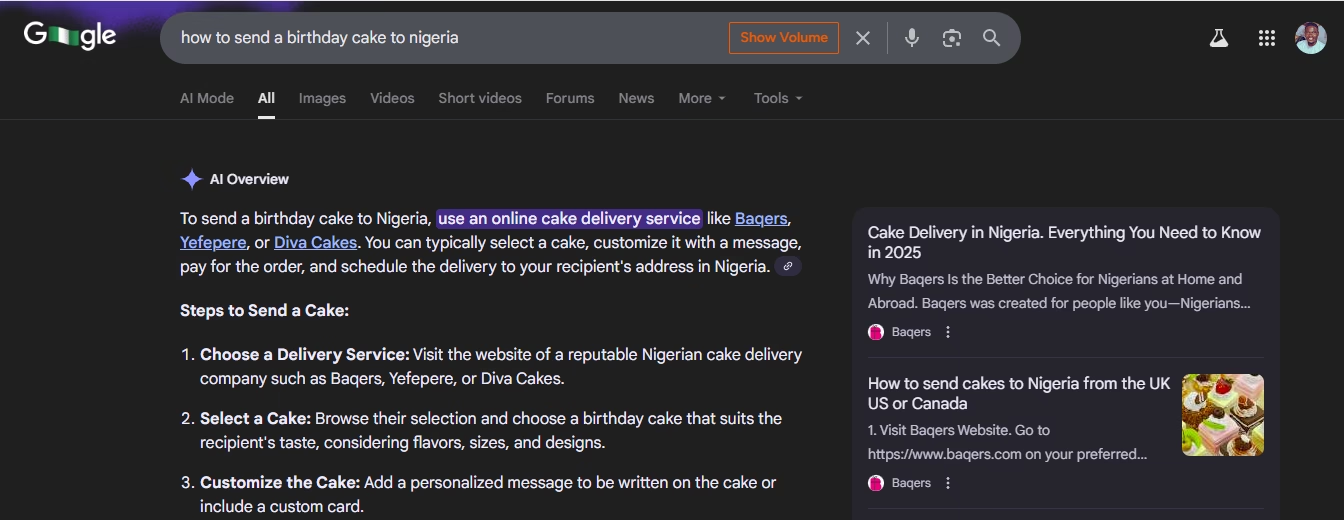
Here was a tiny site with low authority outranking the giants in a space where visibility is supposed to be impossible without it.
That’s when it hit me. If a low-authority site can get cited in AI Overviews, then the old rules of SEO aren’t the only rules anymore.
And that result raised the real question: what signals are AI Overviews actually rewarding?
three reasons why it worked
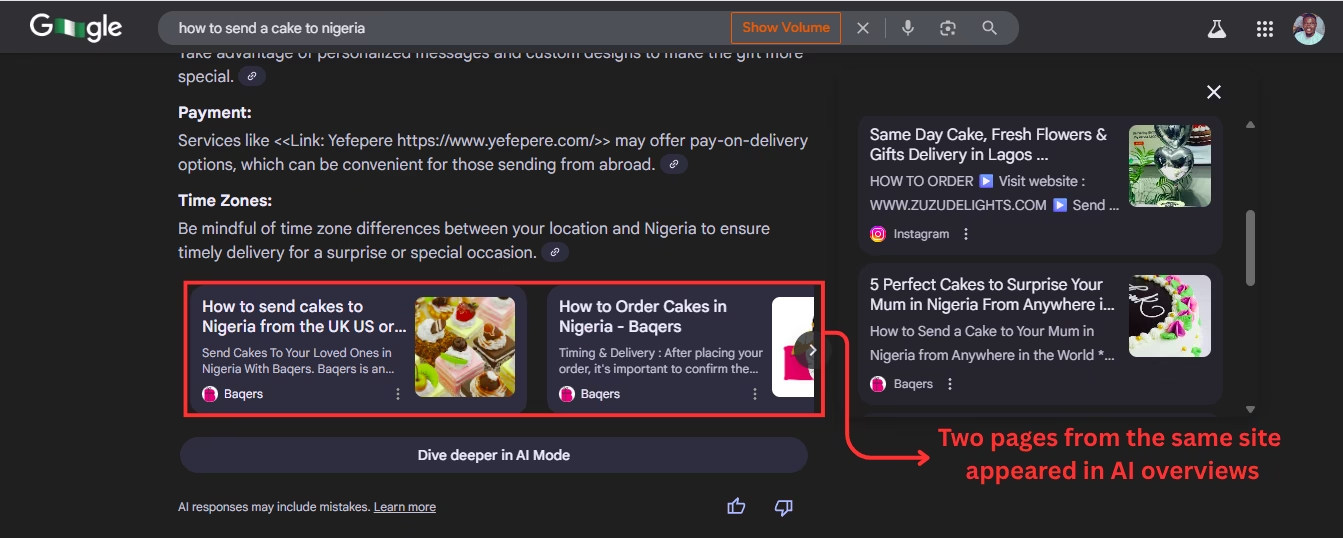
At first, I thought the result might just be a one-off. But when I checked the second article, it was the same. The brand got a linked mention in AI Overviews.
The content was intentionally designed to give the site authority signals strong enough for AI to notice. And the authority had nothing to do with backlinks or trying to hack domain authority. It came down to structural clarity.
Here’s what actually made it work:
1. strategic brand mentions
One of the first choices I made when writing those articles was to treat the brand as more than just an extra detail. I positioned it as the answer.
Instead of only solving problems in a generic way (like “how to order a cake online” or “best pastries for birthdays”), I wove the brand into the solution naturally.
If someone is reading about cake delivery, it makes sense to mention that this particular bakery offers fast, reliable delivery. That way, the content shapes a narrative that Google’s AI could pull from.
That’s what Ahrefs uncovered in the research I mentioned earlier. Branded web mentions show the strongest correlation with being cited in AI Overviews. Most people assume branded web mentions have to happen on third-party sites, and yes, that’s good. But you can use your own site as the first point of control.
Think of it like telling your own story. AI models are scanning and connecting dots across the web, and they’ll use the signals you give them if you repeat them consistently.
For the bakery site, every time I mentioned their cake delivery service and their brand name, it was deliberate, so that AI could register and eventually cite.
2. structure and skimmability
If there’s one thing both search engines and readers agree on, it’s that messy content doesn’t win.
That’s why I paid special attention to how the articles were structured. Headings, subheadings, bullet points, short paragraphs, etc. Everything was designed to make the content scannable. AI models need to parse information quickly and extract the right chunks.
If your content looks like a jumbled wall of text, AI struggles to parse it. But if it’s clear and broken into logical sections, you’re essentially doing the AI’s job for it.
This isn’t new to SEO, of course. We’ve always known that clean formatting helps both search engines and readers. But in the world of AI Overviews and other LLMs, it matters even more.
That’s exactly what I aimed for with the bakery articles. Each piece was built like a roadmap that’s easy to skim and cite.
3. consistent signals across multiple articles
One article alone might not give a strong signal to AI. That’s why I published three.
In each article, I repeated the same core point about the bakery’s cake delivery service. Not word-for-word, but consistently enough that the message was clear for anyone (and AI, of course).
LLMs learn by spotting patterns and the context in which a brand appears. The more consistently a theme shows up across your content, the more likely AI is to treat it as fact.
This is why I deliberately spread the narrative across multiple posts. I wanted to make sure that, no matter which query the AI was summarizing, the brand’s cake delivery service would surface as part of the answer.
That worked too.
AI didn’t just cite the site once. It did the same for other queries. It treated the brand like a credible player in the space.
what this means for low-authority sites
LLMs are now scanning for who can answer the user’s question clearly and in a way that’s easy to digest.
That means structure, trust signals, and readability are becoming as important—perhaps more important—than domain authority.
Smaller brands and independent creators suddenly have a new way in. You don’t need decades of backlinks to show up in AI Overviews.
If your content is structured well, skimmable, and genuinely useful, AI can (and will) pull you into the spotlight. So, even if your domain authority is a humble 5, you can still show up next to giants if you play your cards right.
the new rules of visibility
My research proves that AI Overviews don’t worship at the altar of domain authority or care much about your link count when you give it exactly what it needs: context, clarity, and consistent signals.
And no, the traditional SEO playbook isn’t dead, but it’s no longer the only way to win. Smaller sites can finally compete without waiting years to build link equity if they’re willing to experiment (like I did) and treat their content like the strategic asset it actually is.
Are you ready for the shift?