I know what works on LinkedIn. I’m just not doing it… yet

in this post
As I’m writing this, I have attended seven LinkedIn masterclasses this year. Seven.
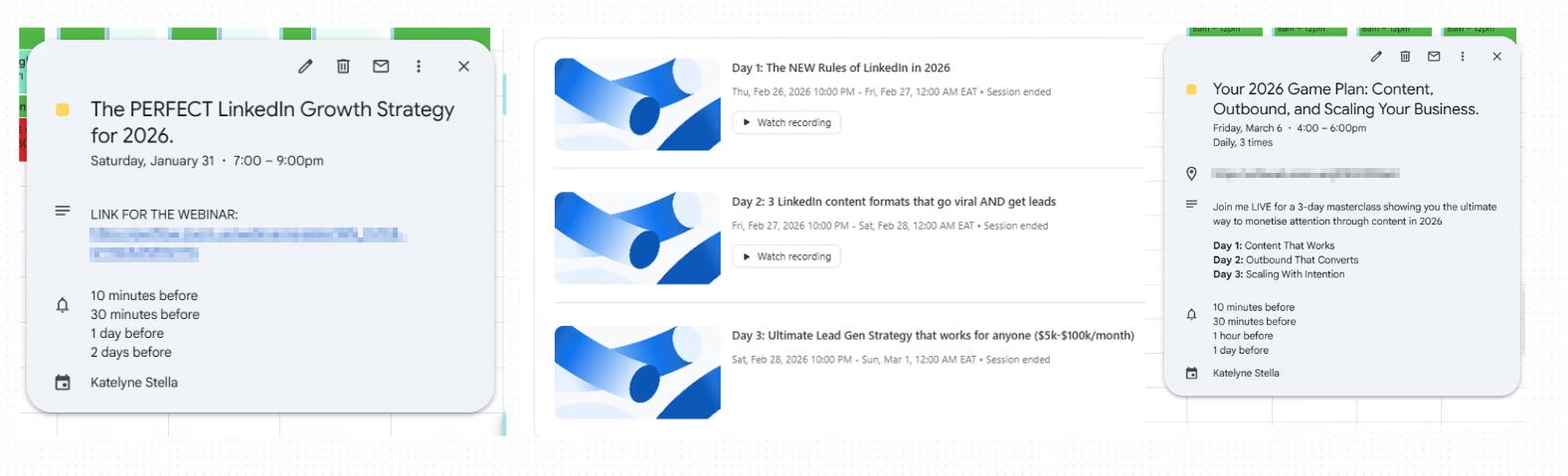
I have notes, frameworks, and a swipe file that would impress most content strategists, including myself.
And yet, if you looked at my LinkedIn right now, you would think I had learned absolutely nothing.
Nobody talks about how strategy is rarely the barrier to growing on LinkedIn. Most of us already know what to do. The actual problem is the strange, paralyzing gap between knowing and doing.
So, I stopped hoarding courses and started looking at what the people still growing on LinkedIn were doing differently.
Here’s what I learned in the process.
what now works on LinkedIn
In early 2025, LinkedIn quietly rolled out its biggest algorithm overhaul in history: The LinkedIn 360Brew. It’s a 150-billion-parameter AI system that replaced thousands of separate ranking models with a single integrated one.
TL;DR: The old LinkedIn system focused on clicks and connections but the new one reads meaning.
| Previous model | 360Brew model |
|---|---|
| Different algorithms handling individual functions | Single integrated algorithm powering all features |
| Manual ranking factors (post timing, tag usage, hashtag strategy) | Analyzes post content to match it with interested audiences |
| Prioritized fast reactions and surface-level activity | Prioritizes meaningful expertise and substantive conversations |
| Incentivized high posting frequency | Values content quality over quantity |
| Less personalized feed experience | Adapts to individual user patterns for customized feeds |
Gimmicks, timing hacks, and hashtags don’t move the needle anymore. LinkedIn’s now asking: “Does this person have real experience here? Is anyone saving this post to reference later?”
Posts that answer those questions—specific case studies, documented results, actual opinions backed by examples—get distributed. Everything else tanks across the board.
No wonder people panicked. According to AuthoredUp’s analysis of three million posts, median reach dropped by 47%, video fell by 72%, and text posts took a 34% hit.
Three content types kept surfacing, no matter which creator I studied or which masterclass I sat through:
1.credibility signals
Generic thought leadership content is dying a slow, very public death. Credibility signals prove you’ve actually done what you’re talking about.
Specific case studies. Documented results. Your exact process. Content only you could have written, specific to your journey, your experiments, your results.
The Jasmin Alic distinctiveness test is the clearest way to check this: cover your name and photo on a post. Would anyone still know it was yours? If the answer is no, you’re being too generic. You’re not showing what makes your experience specific and unique. The algorithm is sophisticated enough to detect this.
| Generic | Specific |
|---|---|
| I’ve figured out the secret to LinkedIn growth. Post consistently, engage authentically, use storytelling, share valuable content, and build community. | I tested posting at different times for 8 weeks. Tuesday at 9 AM got 47% more saves than Wednesday evening. |
Here’s why timing matters less than you think and what drives reach on LinkedIn now.
2.lead magnets
Good lead magnets solve one specific problem , not a broad, vague pain point. And they teach something your audience can use immediately.
| Broad and unspecific | Actionable and immediately useful |
|---|---|
| How to get new clients | 6 places to find B2B companies that hire content marketers |
One makes someone think “maybe,” the other makes them think “I can do this today.”
3. tactical call-outs
Call-out posts are underrated, but they’re one of the most effective.
They name something overlooked or challenge a norm in your industry, and they work because they break the silence. People are constantly agreeing with things they actually disagree with but stay silent. A well-placed callout lets them finally voice that disagreement—and disagreement drives engagement.
In return, your comments section fills with people defending their position, refining yours, or sharing it with their network.
Here’s an example from my own work:
“I hate that we’ve been sold the idea that posting on LinkedIn is enough. The truth is social platforms are ‘rented land’. They are visibility platforms. What you do with that attention is what matters! So I’d say build an audience you actually own instead, and your email list allows you to do just that!”
the catch
Don’t call something out just to start a fight. Only push back on things you actually disagree with and can defend. Otherwise, you’ll spend the comments defending a position you don’t even hold.
now, here’s what makes all three content types work
Credibility signals, lead magnets, and tactical call-outs work because they’re built on two non-negotiables: experiential authority and profile-content alignment.
experiential authority
Experiential authority means everything you post proves you’ve actually done what you’re talking about. Not theory. Not borrowed wisdom. Your experiments, your results, your specific journey.
Look at it this way, you ‘claim’ you are a content marketer, but what have you done or what project did you take, and with what approach? This is how you show authority.
profile-content alignment
Profile-content alignment means your LinkedIn profile and your posts tell the same story.
The 360Brew system reads your profile as a prompt. It uses your headline, about section, and stated experience to classify your expertise, then checks whether your posts match. If they don’t, the algorithm can’t categorize you, and what it can’t categorize, it doesn’t amplify.
For example:
- Headline: “LinkedIn Growth Strategist | I help creators build sustainable reach without the hustle”
- About section: “I focus on three things: LinkedIn algorithm changes, content strategy for creators, and sustainable growth. Everything I share comes from testing and documenting what actually works.”
- Pillar topics mentioned explicitly: “LinkedIn algorithm,” “content strategy,” “creator growth”
This is tricky, especially for newbies with no experience, but my advice is to start documenting everything you do around 1-2 topics. Your experiments, what failed, what worked, the exact process. That’s how you train the algorithm to recognize you.
Again, knowing all this and actually doing it are two very different things. So, let’s address the elephant in the room:
why do we keep learning instead of doing?
Completing another masterclass feels safer than writing a post that might flop. And this right here is creation paralysis.
It is the overwhelm that kicks in when you have absorbed too many strategies, and instead of creating, you freeze while still feeling productive because at least you are learning something, right?
For me, the paralysis showed up in three oddly specific ways:
-
Box-fitting Stella: I’d draft something genuinely niche and specific, then sand it down until it was safe and broadly palatable. Because who am I to say that?
-
Opinion-toned Stella: I’d have some sharp takes then soften every edge until the post was meaningless. The experts don’t say this, so why would I?
-
Gather-them all Stella: I stayed broad and called it strategy. Really, it was just fear dressed up as business sense.
I know all my impostors by name. That’s also how I know execution feels irreversible in a way research never does.
If I publish something and it flops, I have to sit with that publicly. If I attend another masterclass, I get to keep believing I’m almost ready.
Consumption feels safe. Publishing doesn’t. The exposure of leaving your words on that timeline and being seen—two likes, ten likes, doesn’t matter. You’re out there.
The knowing-doing gap is not a knowledge problem. It will never be. It is a risk tolerance problem wearing a knowledge disguise.
Harsh? Yeah. But until you name the real barrier (of risk, not knowledge) you’ll keep consuming and never ship.
every month you don’t post, the algorithm forgets you
The more I learned, the higher my own bar got but somewhere around Masterclass #4, the frameworks stopped helping. Every new system made my drafts feel inadequate. Every viral case study made mine feel unfinished.
The algorithm is not waiting for you to feel ready, and it never will.
The creators who maintained or grew reach kept showing up. This matters because the 360Brew system builds a personalized model of you based on your last two to three months of activity. Every month you skip posting is a month the algorithm has no data on you. That’s you actively losing ground while others gain it.
Every day you tell yourself you’re ‘still researching,’ you’re actually procrastinating.
I’ve been living in that tunnel for far too long, but now I’m out and here is:
the content system I’m actually committing to
The foundation I’m using comes from the Notus Content Archetype framework by Marvin Sanginés.
This framework organises everything around four communication lenses:
- Tactical: actionable, implementable advice. Example: “I’ve written 12,900+ posts for 200+ founders. These are the six hook structures I see in top performing posts”.
- Aspirational: specific growth stories and outcomes, the kind that make someone think “that could be me.” Example: “Here’s how I went from 500 followers to 5K in 6 months without a content calendar”.
- Insightful: trend analysis with your takes. Example: “Why Instagram’s algo favors nano creators”.
- Personal: anecdotes, build-in-public updates, honest reflections. Example: “What I got wrong about LinkedIn and what I’m doing instead”.
Every piece of content I create will map to one of these four lenses, and every lens will draw from one of four content contexts:
- Personal experiences and experiments
- Peer experiences and case studies
- Current events and platform updates
- Process breakdowns
This ecosystem removes the excuse to overthink. Before I even open a blank doc, I have 16 directions to choose from. Creation paralysis doesn’t stand a chance.
my weekly content mix
On top of that structure, I am committing to a weekly content mix with real proportions.
-
70% niche content: tied directly to my work and service. This builds topical authority and trains the algorithm to know who I am.
-
20% growth content: broader topics that bring in audiences outside my immediate network.
-
10% storytelling: behind the scenes, experiments, and specific results.
That’s at least four posts a week. A commitment I can sustain.
my post structure
For post structure, I’m using the SLAY framework by Lara Acosta: Story, Lesson, Action, You.
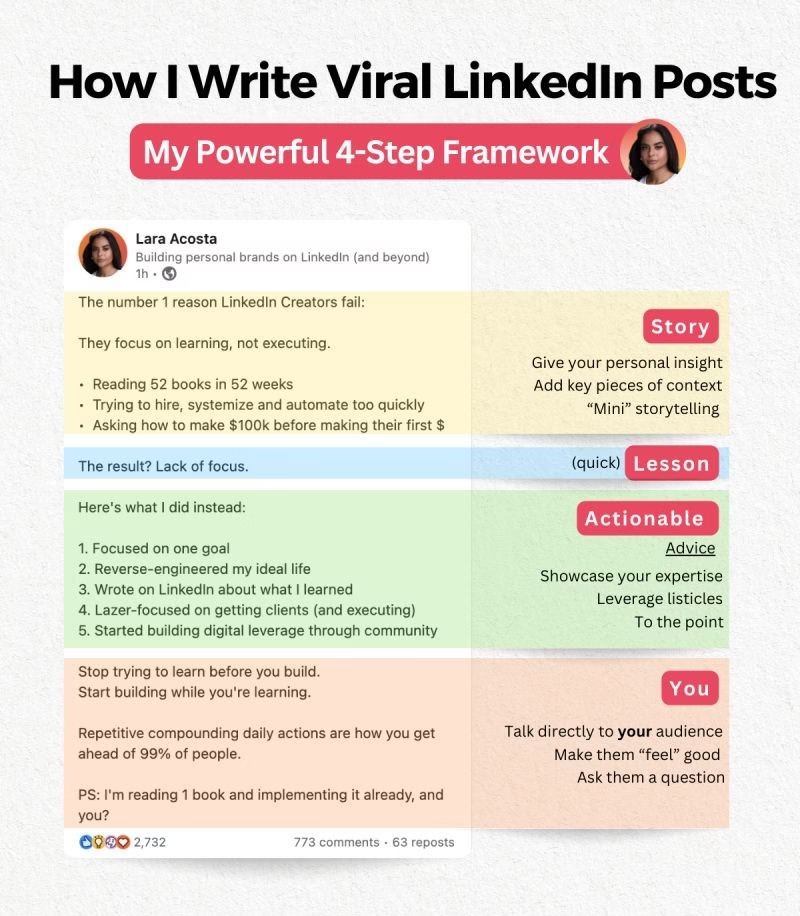
It keeps me anchored in lived experience rather than borrowed theory. I open with a moment or result, extract the lesson from it, tell readers what to do about it, and end with a direct prompt to them. It’s a structure that feels conversational, not templated.
So how do I know if the system is working? I track saves, not likes.
Right now, one save on LinkedIn drives five times the reach of a like. That number alone should change how you think about what you are building toward with every post.
Likes feel good, but they’re vanity. Saves tell you whether you made something worth keeping, and that is the signal that moves reach in the 360Brew era.
the only thing left is to start
That’s my system. Four lenses, four content contexts, one weekly commitment, and one metric that matters.
If you’re a solid 10 procrastinator, Mincave’s got you. Join the waitlist for the LinkedIn Challenge and you’ll have people holding you accountable every single day.
Disclaimer : LinkedIn’s algorithm changes constantly. Track your own analytics to see what actually works for your audience.