how we landed our first content marketing client (without spending a dime)
We’ve sent exactly 30 cold emails. 5 people agreed to talk to us. 1 became a paying client.
Somewhere in that funnel, we learned more about what actually works in cold outreach than we would’ve in a year of reading blog posts about “the perfect subject line.”
Thing is, cold email gets a bad rap. Everyone associates it with spam, with scale, with the same generic “I’d love to pick your brain” message blasted to 10,000 people at once. So nobody talks about what cold email actually is when you do it right: one of the highest-signal ways to test whether you understand your customer.
I co-run The Other Guys. It’s our scrappy two-person content marketing agency that needed clients and had $80 to our name. We decided cold email was the only channel where we could start from zero and have results in a week (more on this later).
Anyway, here’s what we actually did, what we learned, and why the 4 people who said no matter as much as the 1 who said yes.
our case against everything else
Before we talk about what works, let’s talk about why we avoided everything else.
Most founders and growth leaders have been pitched to death. They’ve downloaded 47 PDFs they never opened. They’ve scrolled past a thousand LinkedIn posts about growth. They’re numb to it.
What they’re not tired of is someone taking weeks to research their company, understanding what they actually care about, and writing them a personal message.
So, we ruled out paid ads immediately. We had about $80 to our name (remember?) and needed to prove the model worked before spending more.
We also ruled out “content-driven inbound” for the same reason: it’s a long game. Write great blog posts, wait six months for Google to rank them, wait another six months for inbound leads to show up. We didn’t have the luxury of time.
And networking events? Sure, if you have time. We didn’t.
So cold email it was. We chose this because it’s one of the few channels where you can go from zero to meeting in three days, with zero budget. And the results are immediately measurable.
how we found people to email
The hardest part of cold email isn’t writing the email. It’s deciding who to send it to.
We started with a simple filter: who do we actually want to work with?
For us, that meant series A and B startups in the B2B SaaS space. Companies that have product-market fit and are starting to scale.
These companies understand the value of content but haven’t figured out how to build an engine yet. Also, they have funding, meaning they can put together a budget and won’t be shopping on price alone.
We looked at the Y Combinator database. They have detailed profiles of founders, company stages, funding, recent news, etc. It’s all there, public, and searchable. Within 30 minutes, we had a list of 50 companies that fit our criteria.
Then came the research phase. For each company on our list, we’d spend a day digging. We:
- Read their blog posts or content to understand their point of view.
- Check their LinkedIn profiles to see who founded the company and what their background is.
- Look for recent funding announcements or milestones.
- Scan their socials to see what they’re talking about publicly i.e, what they care about, what problems they’re surfacing, and what they’re trying to build.
The goal was to find something specific to reference in the email. Not “hey, I noticed you’re in SaaS”. That’s just creepy and incredibly vague. More like “I saw your recent interview about scaling your go-to-market team, and I think there’s a content opportunity you’re missing.”
Once we had that specific angle, we’d find the right person to email—usually the founder or Head of Marketing. That’s the person who actually makes decisions about bringing help on, especially marketing help.
LinkedIn is where we found most of them. Public profiles, job titles, email addresses scattered throughout.
the email template (yes, we’re sharing it)
We used a pretty simple structure:
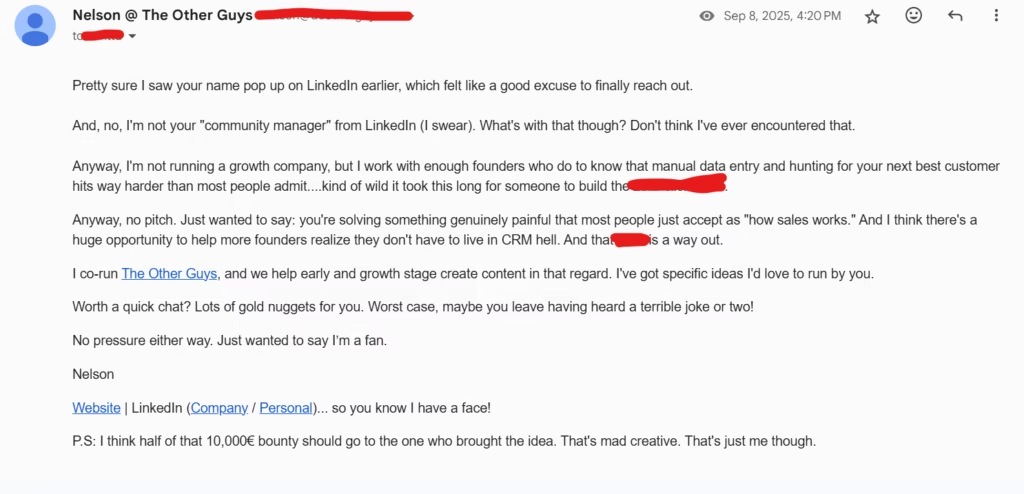
That’s it. 45 seconds to read.
We noticed something about them (the LinkedIn community manager thing. A real observation, maybe a little weird they’re pushing it). We made a joke about it. We showed we actually understand their product and the problem it solves. We didn’t oversell what we do. We acknowledged the joke about the bounty because we’d clearly done our homework on them.
Sent it on a Tuesday afternoon. Got a reply within two hours.

our not-so-annoying follow-up cadence
We have different follow-ups for different scenarios, and each one serves a specific purpose.
scenario 1: they opened your email but didn’t reply
We wait 3 days, then send something short:
[name], hi!
Quick bump on this. Figured it either got buried or just isn’t the right timing.
No worries either way. Just didn’t want it to disappear completely.
Best,
Nelson
That’s it. We’re not explaining our value prop again or trying to convince them. We’re just saying “hey, this exists, in case you care.”
It’s a 15-second read. Low friction. If they’re interested but forgot, we reminded them. If they’re not interested, they can ignore it and we move on.
scenario 2: they replied but no answer afterwards
This is where you need to be careful. They engaged. They’re interested. But they haven’t said yes yet. This is where we send:
[name], hi!
I’m breaking one of my own rules here (the “don’t be that guy who follows up too soon” rule), but figured I’d risk it.
Did you get a chance to flip through the doc? I promise it’s not homework.
Just would love to get your take: where things clicked, where they didn’t, or anything you think we should double down on.
No rush if you’re swamped. Just wanted to keep this on your radar.
Best,
Nelson
Notice we’re asking for feedback, not a meeting. We’re lowering the barrier to engagement. That’s a way easier ask.
And once they engage with feedback, then you move toward a call. You have to acknowledge reality: they’re busy, they probably didn’t read it, and we’re okay with that. We’re giving them an out while also creating a reason to engage.
scenario 3: they didn’t reply to follow-up #1, and it’s been a week
This is your last one before you move on. Make it count, but keep it human:
[name], hi!
Alright, I’m gonna stop emailing you after this one. Promise, haha.
Just genuinely curious: was this just terrible timing, not a fit, or did it land in spam? No judgment. Just helps us know whether to try again in a few months or leave you alone entirely.
Cheers,
Nelson
This is our “respecting your time” email. You’re giving them an exit ramp, but you’re also asking a real question that might spark a response.
Sometimes people feel bad about ghosting you, and when you explicitly say, “I’ll stop,” it actually makes them want to respond. It’s counterintuitive, but it works.
our cadence:
Day 0: Send initial email
Day 3: First follow-up (the buried/timing one)
Day 7: Second follow-up (the feedback request)
Day 14: Final follow-up (the “respectfully bowing out” one)
Then you stop. You add them to a “check back in 3 months” list, but you stop emailing them now. If they come back, great. If not, you move on.
sometimes the email was good, and they just don’t want it.
Not every silence means you screwed up.
Sometimes the timing is genuinely bad. Sometimes they already have a solution. Sometimes they’re worried about your price (even though they haven’t asked). Sometimes they just prefer working with people they already know.
Sometimes they opened it, thought “this is interesting,” and then forgot about it forever because their CEO asked them to drop everything for a fire.
the tools we use
We often get asked what tools we use to manage our cold email campaigns. Truth is, we’re not using much of anything.
email:
Gmail, because it’s Gmail. We set up a simple label system to track replies, follow-ups, and dead ends.
tracking:
We use Streak. It integrates directly into Gmail and lets us track email opens, clicks, and replies without having to jump between platforms. We can see exactly who opened the email and when, which tells us if they’re actually engaged or if it just landed in spam.
It costs about $10/month for the basics. Honestly, it’s worth it just so you’re not manually checking your inbox a million times, wondering if someone read your email. But we use the free version.
monitoring:
We use a Trello board to organize prospects by stage:
- To Research
- Email Sent
- Waiting for Reply
- Met
- Deal or Pass
This gives us a visual sense of our pipeline and makes it impossible to forget about someone mid-process. It’s dead simple, free, and it works because we actually use it.
research:
LinkedIn, Google, Y Combinator database, and Crunchbase (free tier), but Google and LinkedIn are doing 90% of the work. The free tiers are plenty for this stage.
scheduling:
We don’t schedule emails. We send them manually, usually Tuesday-Thursday, around 10 AM.
Oh, and we use LinkedIn DMs, but not for cold outreach. We connect with other founders and agency heads in the space, build actual relationships, and bounce ideas off them.
Sometimes we’ll say, “hey, I’m planning to reach out to the founder at [company]. Mind taking a quick look at what I’m sending?” And we get feedback from people in our network before we ever hit send.
the numbers
Okay, here’s where we flex a little bit. In our first campaign, we sent 30 emails and booked 5 qualified meetings. That’s an 83% open rate, 42% reply rate, and 16% meeting booking rate.
Those numbers are way above the industry average. And yes, we’re proud of them. But it’s important to look beyond the numbers too:
all 5 of those meetings were with people we could actually help
We didn’t game the system to get “high reply rates” on unqualified leads. Every person we emailed was someone we’d legitimately done research on and thought might benefit from what we do.
of those 5 meetings, 1 turned into a client
Now, that’s not 100% conversion, but it’s not bad for people who didn’t know us 72 hours before. The other 2 said, “not now, but keep in touch,” and we have. That relationship has value.
we got feedback that’s been invaluable
Even the “no” meetings gave us insight into what we were communicating effectively and what we weren’t. One founder told us our positioning was confusing. We changed it. Better messaging = better conversion down the line.
it cost us exactly zero dollars to land these clients
Our time, yes. But no ads, fancy tools, and no $10K personal branding agency to “build our brand.”
and so what?
And so, if you’re a small agency or founder, you’ll want to know these things about cold outreach before you start.
first: research is not optional
You cannot send good cold emails without actually learning something about the person you’re emailing. Period.
This is the part that prevents most people from doing cold email successfully, because it requires you to slow down and actually think. But that slowness is your competitive advantage. Everyone else is blasting.
second: authenticity is a superpower
When you actually care about the person you’re talking to, it shows. When you’re just trying to hit a numbers target, it shows even more.
third: volume is a trap
Sending 500 emails at a 10% reply rate is way worse than sending 50 emails at a 40% reply rate. One is scalable chaos. The other is a real business.
We’ve intentionally prioritized quality because sustainable growth requires relationships, not just pipeline numbers that evaporate.
fourth: follow-up matters a lot
The second and third emails are where a lot of your wins live. Sometimes, people don’t see the first one. It gets buried. Or, they’re too stressed after the day’s work to come and read your “give me 30 mins of your time”. Plus, life happens.
Give them another chance. Just don’t be creepy about it.
fifth: build in public
We share what we’re learning on our newsletter and LinkedIn. It’s not quite the polished highlight reel. But it’s our real numbers, the failed experiments, the 2 AM group chats where we question everything.
That transparency attracts people who want to work with real humans, not some corporate agency. It also gets people to follow us, which means when the cold email lands, they already have a little familiarity. The numbers back this up too:
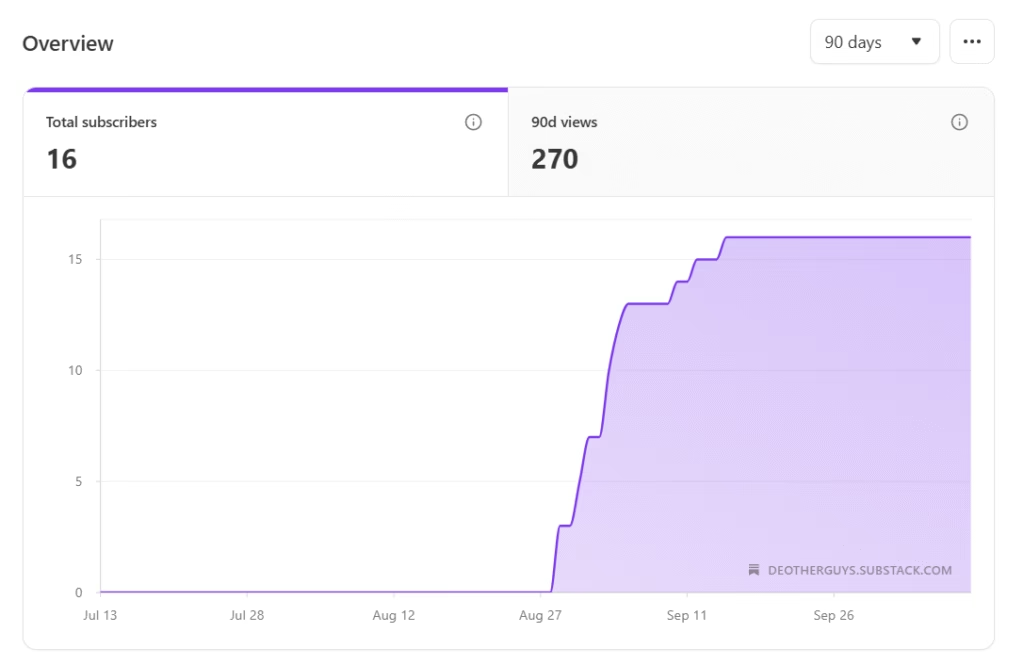
Over the course of a month, we’ve gotten 270 eyeballs on what we’re building. All from two posts at that.
cold email isn’t sexy
Nobody’s going to frame a screenshot of their first cold email reply on the wall. It’s manual, it requires patience, and it doesn’t feel scalable, which is kind of the point.
But cold email does something that other acquisition channels struggle with. It proves you understand your prospect.
Every email is a mini-marketing test. Does the person care? Can you communicate your value in 45 seconds? Do you know their business well enough to articulate a problem they care about? Does your solution actually fit their situation?
If you can’t nail these fundamentals with cold email, no amount of paid ads, content marketing, or fancy funnels will fix it. You’ll just amplify a broken message to more people.
For content agencies specifically, this matters even more. For example, at The Other Guys, we sell something that most founders don’t fully understand yet. They know they need better content. They don’t know what “better content” actually means, costs, or how it transforms their business.
Cold email forces us to get crystal clear on that value prop because we don’t have brand recognition to hide behind.
By the time we send that first email, we know exactly what we’re offering, who we’re offering it to, and why we believe it matters. We’ve thought through the problem so thoroughly that when someone replies, we’re ready to have a real conversation.
None of this required funding or a fancy brand. None of it required us pretending we had it all figured out on day one. We just showed up, did the work, and actually gave a damn about the people we reached out to.
And honestly? That’s become our whole brand.
ready to land your first clients too?
Start tomorrow morning.
Pick 3 companies you genuinely want to work with. Spend 2 hours on each one. Find one specific, interesting fact about them that you can reference. Write them an email. Hit send.
Then do it again the next day.
The work is in the consistency and the care. Everything else follows from there.