how I contacted 100 potential freelance writing clients in 5 days

in this post
A few weeks ago, someone told me cold emailing doesn’t work anymore. Instead of arguing, I opened a spreadsheet. My goal wasn’t to land new freelance writing clients or even to get a reply. I simply wanted to answer one question:
If I reached out to 100 potential clients in five days, what would happen?
That experiment took me through job boards, career pages, founder websites, and a few unexpected corners of the internet.
In this article, I’ll walk you through the platforms I used, what surprised me, and how you can build your own client pipeline instead of waiting for jobs to appear on your timeline.
why I started the 100-client challenge
One thing I’ve learned over the years is that there isn’t just one way to get clients.
I create content consistently on my Instagram page, so I receive inbound inquiries from businesses that find me online. That’s been a huge blessing, and it’s proof that building a personal brand works.
But I never want to rely on just one source of opportunities.
A few weeks ago, one of my students reached out to me with a question:
“Is cold emailing still effective? I don’t think it works anymore.”
It made me think, because I hadn’t intentionally tested it in a while. The writing industry has changed. AI has emerged. Hiring has changed. Surely the way we find clients has changed too.
So instead of debating it, I decided to run an experiment.
I challenged myself to identify and reach out to 100 potential clients in five days.
how I structured the challenge
Once I knew what I wanted to achieve, I had to set rules. I wanted to make the challenge as transparent as possible, so the first thing I did was announce it publicly on social media. That way, I’d be accountable to more than just myself.
Next, I set four ground rules:
reach out to 100 prospects in five days
100 prospects sounded like a lot of work (especially with other things on my plate), so I broke it down to 20 per day. The target was to identify and contact 20 potential clients each day until the fifth.
I wasn’t chasing replies. I wasn’t measuring success by how many discovery calls I booked. My only job was to show up every day and do the work.
track every prospect in a spreadsheet
| No. | Industry | Brand | The problem | Contact and role | Contact details | Status |
|---|---|---|---|---|---|---|
| 1 | Wedding planning | [Brand name] | No blog; service pages thin | [Name], founder | [email address] | Sent |
| 2 | Marketing agency | [Brand name] | Case studies out of date | [Name], head of content | [email address] | Replied |
| 3 | Roofing | [Brand name] | No site copy beyond homepage | [Name], owner | [email address] | Follow up |
Contact names and addresses replaced with placeholders.
I created a simple spreadsheet to keep everything in one place.
For every company, I recorded:
- Company name
- Industry
- The problem of the brand
- Contact person (if available)
- Email address
- Status
This turned out to be one of the smartest decisions I made. Without a tracking system, it’s surprisingly easy to contact the same company twice, forget to follow up, or lose great opportunities you discovered earlier in the week.
personalize every message
There was one rule I refused to break: no duplicate outreach.
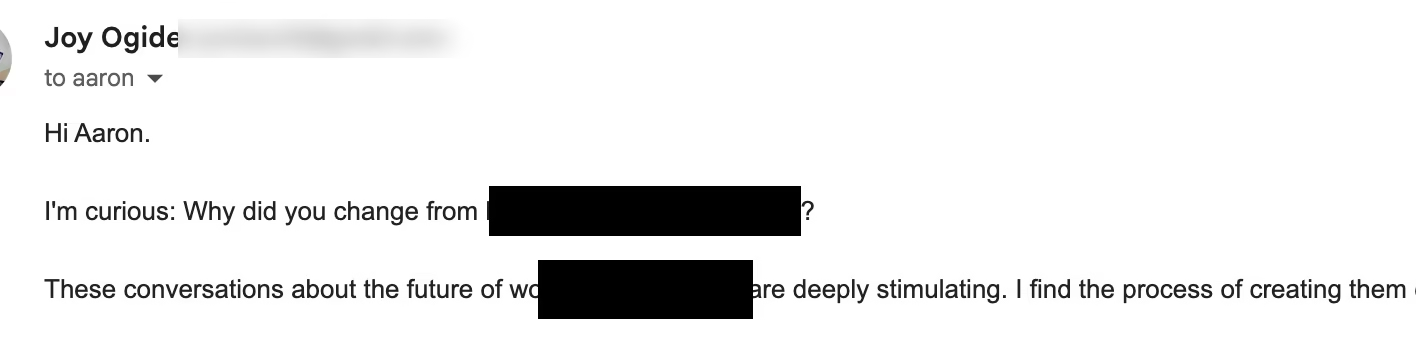
Every email had to mention something specific about the company, whether it was their website, a recent blog post, a product launch, or an area where I believed my writing could help.
Did it take longer? Absolutely.
But personalized outreach respects the person’s time. It also forces you to do proper research rather than treating every prospect as just another number on a spreadsheet. My own response rate was 23%, and the fastest reply came five minutes after I hit send.
use more than one way to find prospects
I wanted to try as many methods as possible, so I checked out every platform I could. Some prospects came from job boards, others from company career pages, some were businesses I found through Google, and others came from founder profiles, directories, or niche platforms.
the platforms that got me 100 prospects
For this outreach, I used five different sources. Every source uncovered a distinct opportunity, and each played a different role in helping me reach my goal. Here’s what made it into my daily workflow.
1. LinkedIn jobs
Best for: companies already hiring
LinkedIn is usually my first stop. It gives you a quick pulse on who’s hiring right now. I searched for terms like “looking for content writer,” “hiring content strategist,” “I need a copywriter,” etc.
I also checked the LinkedIn Job board, paying attention to remote writing roles.
2. company career pages
Best for: opportunities before everyone else
Not every company advertises jobs on LinkedIn. Many simply update their careers page.
So, whenever I found an interesting company, I’d visit its website and check whether it had a Careers or Work With Us page.
Some roles had been sitting there for weeks without much visibility.
3. CaveJobs
Best for: curated content opportunities
This challenge is actually how I discovered CaveJobs.
Instead of scrolling through hundreds of irrelevant listings, I found a curated collection of writing and marketing opportunities. The filtering is already done, and that saved me hours of searching across the week.
4. Google
Best for: finding companies, not just jobs
This was probably the most underrated part of the challenge.
Instead of only searching for “freelance writing jobs,” I started searching for companies.
I used Boolean search operators to uncover businesses in specific industries, looked for agencies with growing content teams, and explored directories I would never have found by relying on social media alone.
5. founder profiles and company websites
Best for: proactive outreach
Some of my favorite prospects never posted a job opening. I found them by browsing founder profiles, reading company blogs, exploring product launches, and paying attention to businesses that were clearly investing in marketing.
If a company was publishing consistently but their content had obvious gaps, that was often enough for me to start a conversation.
the cold-email process
One thing I learned from this entire process is that cold-emailing has very little to do with sending the email itself. The main work happens before you hit ‘send.’
Here is the five-step workflow I followed:
step 1: find the right companies
Before I wrote a single email, I created a daily list of everyone I wanted to reach. I chose a specific industry to focus on each day, then contacted 20 companies in that industry.
Tools I used:
- Google Search (example: “Wedding Planner in Ohio”)
- Industry directories
step 2: research the brand thoroughly
This is where most cold emails fail. People spend five minutes writing an email and 30 seconds researching the company, when it should be the other way around.
Before reaching out, I visited the company’s website, looked through their blog, checked their LinkedIn page, and tried to understand what they were building.
Questions I asked myself included:
- Do they publish content regularly?
- Are there obvious gaps in their website copy?
- Have they recently launched a new product?
- Who is responsible for marketing?
Those answers helped me write emails that sounded relevant.
step 3: find the right contact
A great email sent to the wrong inbox is still a wasted email. Whenever possible, I looked for the marketing manager, content lead, founder, or someone directly responsible for growth. If I couldn’t find an individual email address, I’d use the general company email—but only after exhausting other options. Even when I used the general email, I’d ask that it be forwarded to whoever handles marketing)
Tools I used
- The Org
- Company Contact pages
step 4: write an email they’d actually read
Every email followed the same simple structure.
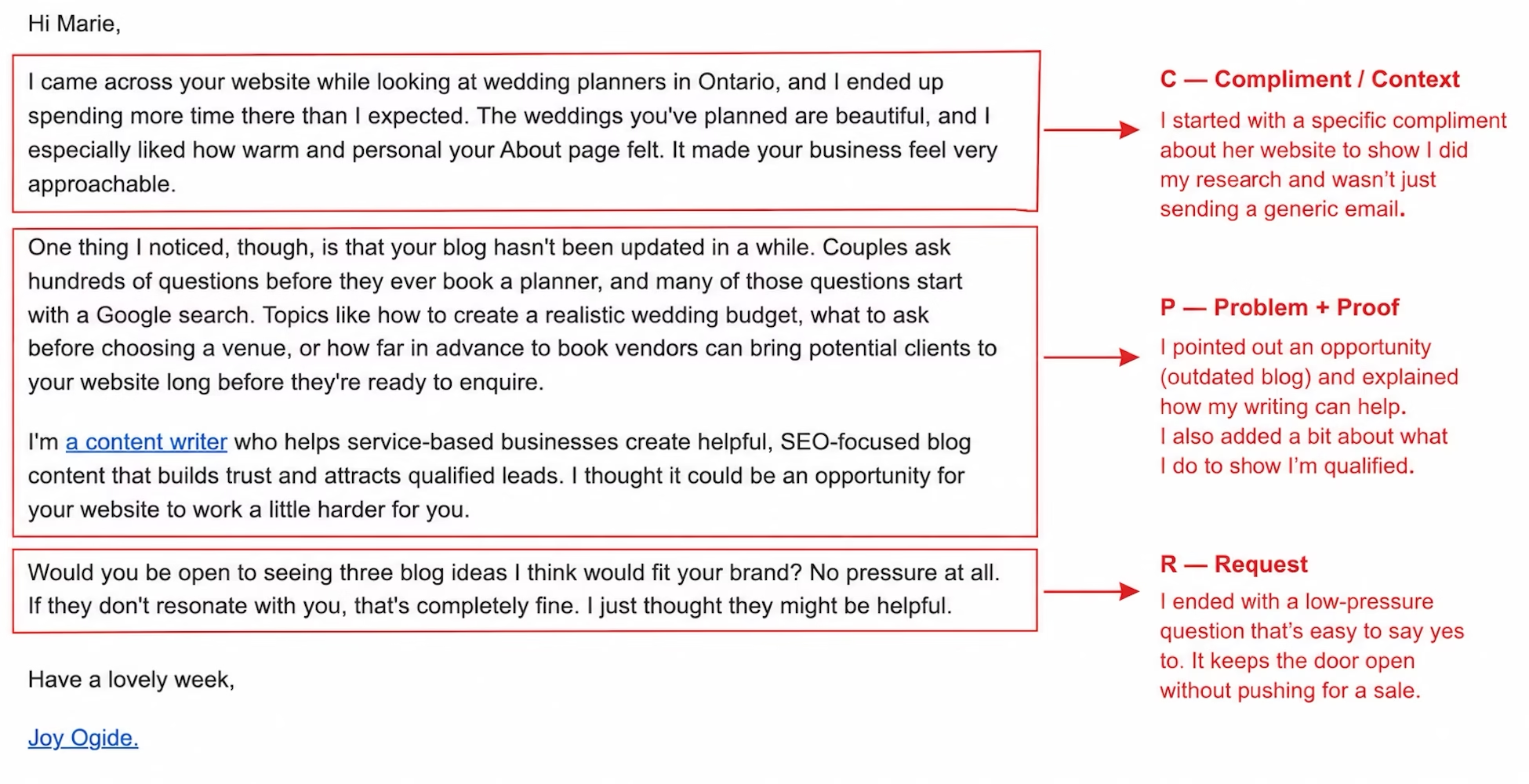
My CPR formula
- C—Compliment or Context
Start with something specific. Mention a recent launch, a blog post, a campaign, or something you noticed about the business. This tells the reader the email wasn’t blasted to 500 companies.
Example:* I came across your website while researching pool care companies in Florida, and I loved how clearly you explain your maintenance plans.*
- P—Problem + Proof
Point out an opportunity where your writing could help. Then briefly explain why you’requalified.
Example: I noticed your blog hasn’t been updated in several months. Consistent educational content could help attract homeowners searching for pool maintenance tips. I’m a content writer who helps service businesses create SEO-focused blog content that brings in qualified traffic.
- R—Request
End with a low-pressure call to action.
Example: Would you be open to seeing a few content ideas tailored to your business?
Here’s a sample of an email I sent to Marie, a wedding planner in Ontario:
Tools I used
- Gmail
- Grammarly
- ChatGPT (to brainstorm ideas or improve clarity)
If the hard part isn’t writing the email but sending it, Lauren Christiansen’s piece on conquering embarrassment as a freelancer covers the emotional side of putting yourself out there.
step 5: track and follow up
The challenge didn’t end after clicking send. Every email went back into my spreadsheet. I tracked the company, contact, date sent, follow-up date, and status. Even if a company isn’t ready today, your email might be the reason they remember you three months from now when a role opens.
Tools I used:
- Google Sheets
- Calendar reminders for follow-ups
four things that genuinely surprised me
When I started this challenge, I thought the biggest lesson would be whether cold emailing still works. It wasn’t. Here are four things that surprised me the most:
1. most companies don’t make it easy to reach the right person
I lost count of how many websites only listed hello@, info@, or support@ email addresses. At first, it was frustrating. I wanted a shortcut to the marketing manager or founder. But it forced me to dig deeper.
I’d check LinkedIn, browse the team’s About page, look through press releases, or use tools like The Org to find the right contact. Sometimes I’d still end up using the generic address, but only after exhausting every other option.
It reminded me that prospecting is detective work as much as it is writing.
2. some industries are much easier to prospect than others
One day, I’d spend an hour finding just a handful of good prospects. The next day, I’d stumble across an industry where companies seemed to be everywhere.
Service-based businesses were often the easiest to research. They usually had websites, contact pages, and obvious opportunities to improve their content. If you’re running your own outreach challenge, don’t be discouraged if one niche feels slow. Try another. Sometimes it’s the market, not your method.
3. personalized emails take longer, but they’re worth every extra minute
There were moments when I was tempted to copy, paste, and move on. After all, I had 100 prospects to reach. But every time I spent a few extra minutes researching a company, the email became easier to write.
People can tell when you’ve written an email for them rather than to them. One reply came five minutes after I sent it, and that prospect became a client.
4. there are far more opportunities than I imagined
This was the biggest surprise of all. I didn’t run out of companies, websites, or ideas. If anything, I had to stop myself from adding more prospects to my spreadsheet. This completely changed the way I think about finding clients.
The internet isn’t short of opportunities.
my 5-day outreach report
Here is how each day broke down, and what I observed:
- Day 1Wedding industry · 5 hoursLuxury service businesses often have polished websites, and owners were easy to find. Many listed their personal emails on their About page.
- Day 2Marketing agencies · 3 hoursEasier to research, since most listed team members and services clearly.
- Day 3Trades (pool care, roofing, plumbing) · 4 hoursMany had weak or outdated websites, making content opportunities easy to identify.
- Day 4Luxury travel · 5 hoursBeautiful brands, but outreach required much more personalization to stand out.
- Day 5SaaS career pages · 4 hoursMany SaaS brands put openings on their career pages first, and only go wider if they don't get competent applicants in time.
Across five days, that came to 21 hours with an average of 4.2 hours per day.
the challenge results, in numbers
What those 23 replies turned into:
- Rejections: 12
- Asked to follow up later: 6
- Clients signed: 3
- Still in conversation: 2
No response (yet): 77
you might be looking in the wrong place
In five days, I found 100 potential clients, received 23 responses, and signed three of them, but the real result was building a prospecting system I can run again whenever my pipeline thins out.
If you’ve been relying on one platform to find clients, let this be your sign to widen your search. You might be surprised by how many opportunities appear once you stop waiting for them and start looking for them.
For a longer look at how this plays out at scale, read how this agency landed their first content marketing client without spending a dime.